On-line analysis refers to analyzing and measuring the composition of materials and various physical and chemical properties. This article mainly introduces ten commonly used industrial analytical instruments to help readers learn, understand and master analytical instruments.
In petrochemical production processes, stabilizing production and ensuring product quality by controlling parameters such as pressure, flow, level and temperature is an indirect control method. Since these parameters cannot reflect the quality of raw materials, intermediates and final products during production, the development of modern industry requires direct process control based on product quality in the production process to achieve optimal operation and management, and truly realize high quality, high yield, safety and low consumption in production. This has driven the rapid development of automatic composition analytical instruments.
Types of Common Analytical Instruments
Automatic analytical instruments (also called process or on-line analytical instruments) form an analysis and measurement system together with a sample pre-treatment system to guarantee good environmental adaptability and high reliability, so that the readings of analytical instruments can represent the detected components.
Analysis Methods:
· Periodic sampling and laboratory testing via laboratory analysis methods.
· Continuous measurement of the content or properties of measured substances using automatic analytical instruments.
Instrument Selection: Instruments adopt multiple measurement principles. Therefore, appropriate testing methods and instruments shall be selected according to the physical and chemical properties of the measured substances during analysis and measurement.
They can be divided into the following categories by different measurement principles:
① Electrochemical type (conductivity type, potentiometric type, pH meter, ion concentration meter)
② Thermal type (thermal conductivity type, thermospectroscopic type, thermochemical type)
③ Magnetic type (NMR analyzer)
④ Radiation type (X-ray analyzer, microwave analyzer)
⑤ Optical type (absorption optical analyzers such as infrared and ultraviolet, light scattering and interference optical analyzers)
⑥ Electron optical and ion optical type (electron probe, ion probe)
⑦ Chromatographic type (gas and liquid chromatograph)
⑧ Physical property measuring instruments (moisture meter, viscometer, densimeter, hygrometer)
⑨ Others (crystal oscillation analyzer, semiconductor gas sensor)
Only part of these types can realize automatic analysis functions.
Ten Commonly Used Industrial Analytical Instruments
1. Thermal Conductivity Gas Analyzer (thermal conductance)
· Working Principle: Analysis based on different thermal conductivity coefficients of various gases.
· Application: Analyze the volume percentage of components such as H2, CO2, NH3 and SO2 in mixed gas.
· Features: The earliest physical gas analyzer; simple structure, stable operation, compact size, widely used in production.
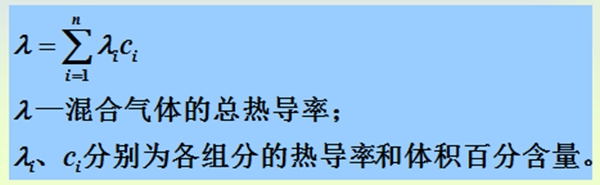
· Thermal conductivity characteristics: Gases have different thermal conductivities — hydrogen and helium have the highest conductivity, while CO2 and SO2 have lower values; conductivity is also related to gas temperature. The thermal conductivity of mixed gas can be approximately regarded as the arithmetic mean of the thermal conductivity of each component, namely:
Assume the thermal conductivity of the measured component is λ1 with volume fraction c1, and the thermal conductivity of the remaining background components is approximately λ2, then:
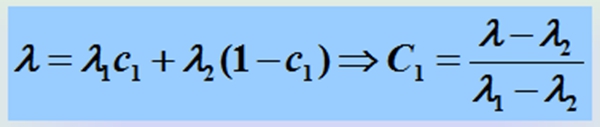
Two prerequisites must be satisfied to apply this formula:
① Except the target component, all other components in the mixed gas shall have identical or very close thermal conductivity coefficients;
② There shall be a significant difference between the thermal conductivity of the target component and the rest components. The larger the difference, the higher the sensitivity, i.e. the greater the change of λ of mixed gas caused by concentration variation of the target component. Pre-treatment is required if this condition cannot be met.
Case: For CO2 content analysis in flue gas, the components include CO2, N2, CO, SO2, H2, O2 and water vapor. SO2 and H2 have vastly different thermal conductivities and must be removed during pre-treatment. The remaining background gases have similar thermal conductivity which differs greatly from CO2, so thermal conductivity method is applicable for measurement.
2. Infrared Gas Analyzer — Optical Analytical Instrument
· Basic Principle: Analysis based on the characteristic selective absorption of infrared rays at specific wavelengths by different gases.
· Features: Wide measuring range, high sensitivity and precision, fast response speed, good selectivity and universal applicability.
· Application: Continuous concentration analysis of CO2, NH3, CO, CH4 and other gases in mixed gas.
Each gas has characteristic absorption peaks within the infrared band. The infrared spectrum between 2~25µm is mainly utilized.
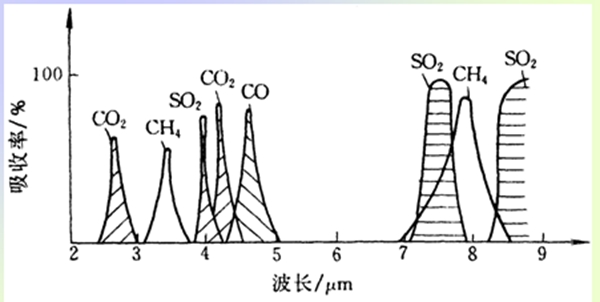
· Measuring Principle: Parallel infrared rays emitted by the infrared light source are selectively absorbed at characteristic wavelengths by the target component, weakening infrared intensity. When incident infrared intensity, gas cell structure and other parameters are fixed, the concentration of the measured component can be determined by measuring transmitted infrared intensity.
The relationship between infrared intensity variation before and after passing through absorbent substance and target component concentration follows Lambert-Beer Law:
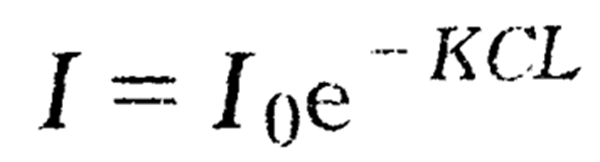
Where K = absorption coefficient of target component; C = target component concentration; L = thickness of absorption layer of light passing through the measured component.
When incident infrared intensity, gas cell structure and other parameters are fixed, the concentration of the measured component can be determined by measuring transmitted infrared intensity.
· Classification:
① Non-dispersive type — Infrared radiation emits continuous infrared spectrum,including infrared rays at the wavelengths of characteristic absorption peaks of measured gas. Analyzed gas continuously flows through the measuring cell; target components selectively absorb radiant energy at their characteristic wavelengths and reduce the intensity of infrared light transmitted through the cell.
② Dispersive type — Monochromatic light measurement mode, utilizing two fixed wavelengths of infrared rays passing through the gas cell. The target component selectively absorbs radiant energy of one wavelength but not the other; the concentration of target component can be obtained by measuring the transmission ratio of radiant energy at the two wavelengths.
· Composition: Infrared radiation source, measuring gas cell, infrared detector
3. Zirconia Oxygen Analyzer — Electrochemical Analysis Method
· Zirconia (ZrO2) is a ceramic solid electrolyte with excellent ionic conductivity at high temperatures.
· Basic Working Principle: Based on oxygen concentration cell. Low-valence oxides such as calcium oxide are doped into pure zirconia and sintered at high temperature to form stable solid solution serving as two electrodes of the oxygen concentration cell. When oxygen content differs on both sides of the cell, an electric potential is generated between electrodes, known as concentration potential, which correlates with oxygen concentration of the two sides.
· Features: Suitable for oxygen measurement under high-temperature environments, high sensitivity, good stability, fast response, wide measuring range, no complex sampling and pre-treatment systems; its probe can be directly inserted into flue ducts to continuously analyze oxygen content in flue gas.
· Necessary conditions for normal operation of zirconia analyzer: Refer to page 123.
· Installation types: Direct insertion type and extraction type.
4. Gas Chromatograph — Physical Analytical Instrument
· Basic Working Principle: Separation based on different distribution coefficients of various substances in the system composed of stationary phase and mobile phase (chromatographic column).The analyzed sample is carried into the chromatographic column by carrier gas. The column is filled with solid adsorbent or stationary liquid which has different adsorption or dissolving capacity for different gases, while its adsorption capacity for carrier gas is much weaker than sample components. Due to varying adsorption/dissolving capacity of each sample component on stationary phase, components exit the column in different sequences and achieve separation. Separated components flowing out sequentially are detected by a detector and processed to generate test results.Chromatographic analytical instruments include two technical procedures: separation and analysis.
· A type of physical analytical instrument capable of completing qualitative or quantitative analysis of dozens of components in mixed samples in a single test.
· Advantages: High efficiency, fast speed, high sensitivity. It can complete qualitative or quantitative analysis of dozens of components in mixed samples in one test.
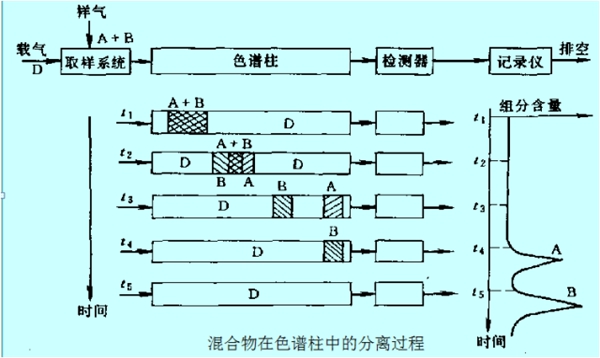
The curve reflecting each component and its concentration varying with time is called chromatogram.When chromatographic column stationary phase composition, column length, temperature, carrier gas flow rate and other conditions remain unchanged, calibration of component elution time enables qualitative analysis based on the different time each chromatographic peak appears; the height or area of chromatographic peak represents the content of corresponding component, and quantitative analysis can be conducted after calibration with standard samples of known concentration.
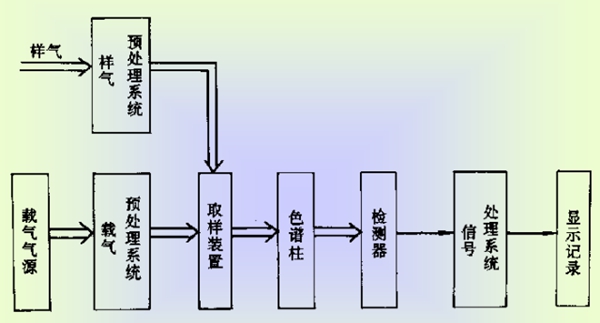
The basic flow of chromatograph is shown in the figure above,Sample gas and carrier gas pass through the pre-treatment system into sampling device respectively, then flow into chromatographic column. Separated components are detected by detector, and relevant signals are processed for output.
· Common detectors: Thermal conductivity detector (TCD), flame ionization detector (FID).
① Thermal Conductivity Detector: Concentration-type detector whose response value is proportional to component concentration.
② Flame Ionization Detector: Based on ionization characteristics of substances; it can only detect combustible components such as organic hydrocarbons ionizable in flame. It is a mass-type detector whose response value is proportional to the mass of component entering detector per unit time.
5. Semiconductor Gas Sensor
· Sensitive material: Semiconductor material
· Features: Hard to eliminate interference from coexisting gases, narrow linear range, only applicable for qualitative and semi-quantitative detection. It has high sensitivity, low cost and simple measurement, making it the most widely used and valuable sensor type.
· Classification: Divided by physical property variation characteristics of semiconductors:
Resistive type: Detect gas composition or concentration via resistance change of gas-sensitive element after contacting measured gas.
Non-resistive type: Direct or indirect gas detection based on characteristic changes caused by gas adsorption and reaction on gas-sensitive elements.
They can also be classified as surface-controlled type and bulk-controlled type according to whether the interaction between semiconductor and gas occurs on surface or inside the material.
1. Resistive Semiconductor Gas Sensor:
· Principle: Oxidation or reduction reaction of gas on semiconductor surface increases or decreases the quantity of charge carriers inside the semiconductor, leading to corresponding resistance variation of sensitive element.
· Gas classification: Oxidizing gases (e.g. O2 with negative ion adsorption tendency) and reducing gases (e.g. H2, CO, hydrocarbons and alcohols with positive ion adsorption tendency). When reducing gas adsorbs on N-type semiconductors (tin oxide, zinc oxide, titanium oxide etc.) or oxidizing gas adsorbs on P-type semiconductors (molybdenum oxide, chromium oxide etc.), charge carriers increase and sensitive element resistance decreases.
2. Non-resistive Semiconductor Gas Sensor
Fabricated based on capacitance-voltage characteristic variation of MOS diodes and threshold voltage shift of MOS field-effect transistors. Such devices have insufficient stability and are only used for gas leakage detection at present.
6. Industrial pH Meter
· Industrial pH meter adopts electrochemical analysis method for on-line measurement of solution acidity and alkalinity, widely applied in petrochemical, textile, food, pharmaceutical industries, aquaculture, water quality monitoring and other fields.
· Representation of solution acidity and alkalinity: Expressed by hydrogen ion concentration, represented by pH value:
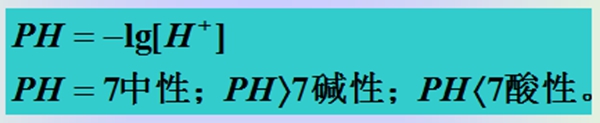
· pH value detection: Potentiometric measurement method is adopted.
Potentiometric Method: Based on electrochemical principles, any metal immersed in conductive solution generates electrode potential between metal and solution, which relates to properties of metal and solution as well as solution concentration and temperature.
· pH measuring cell:
Structure: Composed of reference electrode, measuring electrode and measured solution. The potential of reference electrode is a fixed value. The electrode potential of measuring electrode varies with hydrogen ion concentration of solution, and the electromotive force of the cell equals the potential difference between reference electrode and measuring electrode, which reflects hydrogen ion concentration.
· Relationship between cell potential E and pH value of measured solution:
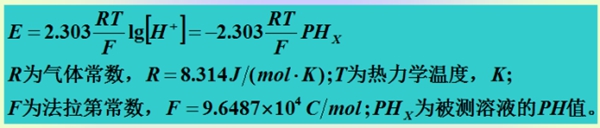
· Electrode structure:
Reference electrode: Two common types: calomel electrode or silver-silver chloride electrode.
a. Calomel electrode: E0=+0.2458V
b. Silver-silver chloride electrode: E0=+0.197V
Measuring electrode: Glass electrode.
· Measuring Principle: In pH measurement systems, the combination of glass electrode as measuring electrode and calomel electrode as reference electrode is most widely used. Total potential E:
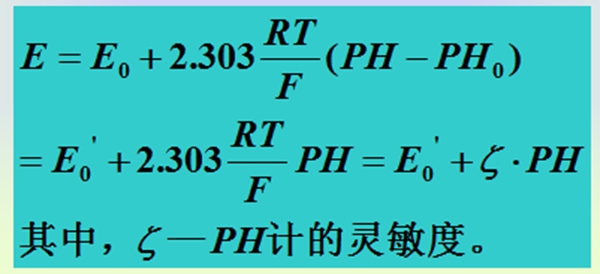
· Reference electrodes are generally calomel or silver-silver chloride electrodes, while glass electrode is the most widely used measuring electrode. The output potential of such measuring cell has a linear relationship with pH value (within the range of 1~10) at constant temperature; the slope of characteristic curve rises with temperature, but curves at different temperatures intersect at one point — isopotential point.
· Direct potentiometry can also be applied to measure concentrations of other ions.
7. Psychrometer
· Application: Measure relative humidity of air.
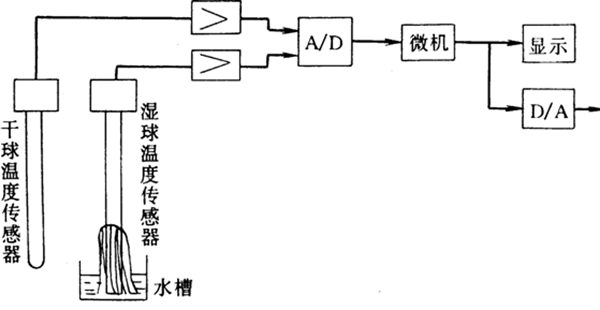
· Composition: Consists of two thermometers,
· Dry-bulb thermometer: Directly measure air temperature.
· Wet-bulb thermometer: The temperature sensing part is wrapped with water-absorbent cotton gauze sleeve kept constantly moist.
· Working Principle: Evaporation of water on cotton sleeve absorbs heat from the temperature-sensing part of wet-bulb thermometer and lowers its temperature. Water evaporation rate correlates with air humidity: higher relative humidity leads to slower evaporation. Under fixed ambient temperature, the temperature difference between dry-bulb and wet-bulb thermometer relates to air humidity, and this correlation is single-valued when air is static or at a specific flow velocity.
· Relative humidity φ can be calculated after measuring dry-bulb temperature td and wet-bulb temperature tw. Water vapor in air is usually unsaturated, so tw<td.
Partial pressure of water vapor in air:

Relative humidity:

Dry-bulb and wet-bulb temperatures can be measured by platinum resistance, thermistor or semiconductor temperature sensors.Saturated water vapor pressure values corresponding to temperatures are tabulated and stored in instrument memory; relative humidity and absolute humidity can be calculated based on measured dry and wet bulb temperatures. The instrument can display gas temperature, relative humidity and absolute humidity.
8. Electrolytic Humidity Sensor
· Principle: Lithium chloride humidity-sensitive element has reduced resistance after moisture absorption and increased resistance under dry conditions; relative humidity can be obtained by measuring resistance value.
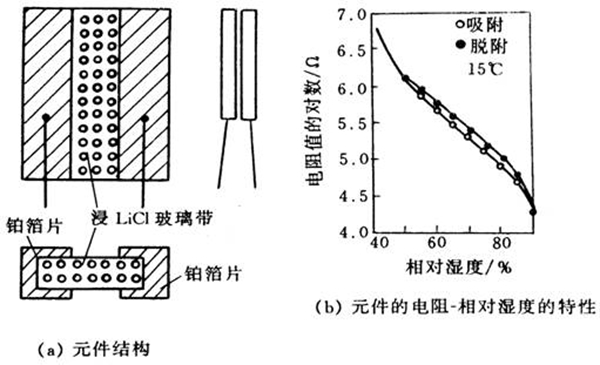
· Features of humidity-sensitive element: Wide humidity measuring range; applicable for high-temperature measurement; reusable electric heating cleaning to remove oil, dust and other contaminants adsorbed on ceramics and maintain measuring precision; fast response speed, excellent long-term stability.
9. Ceramic Humidity Sensor
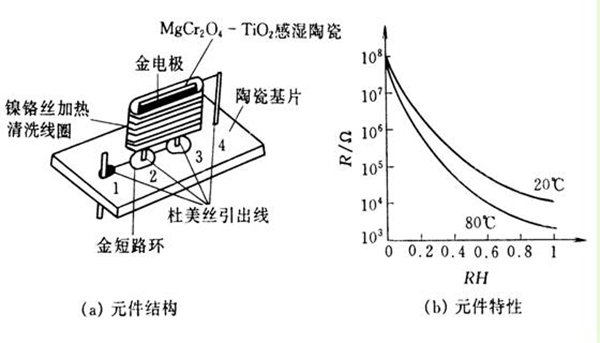
· Principle: Microcrystalline surface of sintered ceramic body absorbs or desorbs water molecules, leading to electrode resistance variation with relative humidity.
· Types: Sintered type, film type and MOS type.
10. Polymer Humidity Sensor
· Principle: Polymers absorb and release water molecules proportionally to ambient relative humidity, greatly raising dielectric constant with increasing water content. Capacitive humidity sensors made of such materials measure capacitance variation to determine ambient relative humidity.
· Structure: As shown in the figure
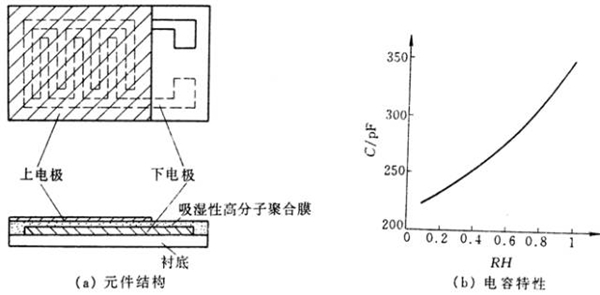
· Features: Fast response, stable performance; operating ambient temperature shall not exceed 80℃